Hobby Horsing equipment has become a world of its own. Halters, reins, bridles, blankets, ear bonnets, fly masks. But you don't need all of that to get started. In our video we picked four pieces of equipment we consider the essentials, and in this article we go through them in more detail. You'll learn what each piece is for, how they work together and what competitions require. It's written for athletes who are just starting out and for parents choosing the equipment. You'll find more tips for beginners in our article How to get started with Hobby Horsing.
01The halter is the foundation
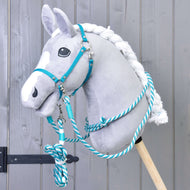
The halter is the foundation of the whole kit. It has no bit and no browband, and it's there for handling your horse: leading it and tying it up. It's also where you attach the rest of the equipment. A lead rope for leading and tying up in the stable, reins for training.
Most of our Hobby Horses come with a black halter included. Of course you can keep more than one halter and colour-match your horse or change its look for the occasion. In our range you'll find halters made of faux leather or webbing, in plain colours, with fringes or with soft fur. Size matters. We make halters in XS, S and M, and the halter should match the size of your horse. Not sure which one? Our article on choosing the right size will help.


02Reins, the most important accessory in the sport
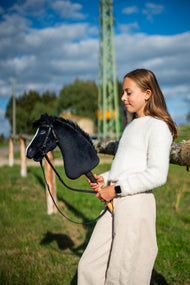
In competitive Hobby Horsing, reins are the most important accessory. You hold them the whole time you ride and keep contact with your horse through them. They help you signal changes of direction and pace and keep a correct posture while riding. They attach to the bridle or the halter, so you'll use them from your very first training session.
Competition rules pay quite close attention to reins. They must be attached on both sides of the muzzle and must not be too long. The rule of thumb: when the horse is held horizontally, the reins must not hang below the rider's knees. Dropping the reins during a ride is penalised. That's one more reason to choose reins that keep their shape and sit well in the hand.
Our reins come in one universal size and fit horses in sizes S and M. You'll find braided, faux-leather and western reins with snap hooks, in dozens of colour combinations, so they're easy to match with the rest of the kit.
03A bridle for training and competitions
A bridle differs from a halter in that it's made for riding. Unlike a halter it usually has a bit and a browband, and often a noseband too. Many athletes use it from their first training sessions, because a horse with a bridle looks complete and professional in the arena.
Under the usual competition rules, a bridle is mandatory in most disciplines. In dressage it's required in every category, western disciplines call for a western bridle, i.e. one without a noseband, and only in show jumping and cross country do the rules allow you to compete with a halter and reins. Even there a bridle is worth it: you get used to your competition kit during training. Before a competition, always check the schedule, as the organiser may have their own requirements. We've described a competition day in detail in our article How does a Hobby Horsing competition work.
Most of our bridles are sold together with reins; only a few models have the reins sold separately, so check the product description when choosing. And if your horse has a sewn-shut mouth where a bit can't be inserted, no problem. The rules allow a bitless bridle with rein rings on both sides.

Comparison
Halter or bridle?
In short: the halter is for leading and handling, the bridle is for riding. Reins attach to both.
Halter
For leading and handling
- No bit, no browband
- Leading, tying up and handling
- With reins you can ride in it too
Bridle
Made for riding
- Usually a bit and browband, often a noseband
- Designed for riding
- Mandatory in dressage and western disciplines
Shop the article
Kit out your horse for competitions


04A protective suit for transport and competitions
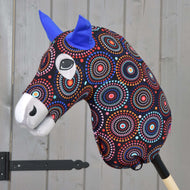
A protective suit protects your horse during transport and storage. It slips over the head and keeps the coat and mane safe from dirt and dust. You'll appreciate it on the way to training and to competitions. If you braid the mane the night before, the suit makes sure the plaits survive the journey intact. For hairstyle inspiration, see our article Hobby Horse mane: 6 styles to try.
We sew our protective suits from stretchy lycra that follows the shape of the horse. The cover has eye openings and shaped ears. You simply pull the bottom tight with a drawstring, like on a jacket. It's machine washable at 30 °C, so it's easy to care for. Choose from dozens of designs, from plain colours to bold prints.
Starter sets
Four accessories that are all you need to start
A halter, reins, a bridle and a protective suit will take you from your first training sessions to your first competition. The halter is for leading and handling, the reins connect you to your horse while riding, the bridle is part of your sporting equipment and the protective suit keeps your horse looking like new. If you'd like to sort out the whole kit in one go, we've put together starter sets in which the accessories match in colour and material.
Browse starter sets
Video
Watch the video
You can see all four accessories in our video. We show you how they attach to the horse and what they look like in action.
- 01Halter
- 02Reins
- 03Bridle
- 04Protective suit
FAQ
Frequently asked questions about Hobby Horsing equipment
What is the difference between a halter and a bridle?
A halter has no bit and no browband and is used for leading, tying up and handling the horse. A bridle usually has a bit and a browband, often a noseband too, and is made for riding. Reins can be attached to both a halter and a bridle.
What does a Hobby Horse need for competitions?
It depends on the discipline. In dressage a bridle is mandatory. In western disciplines you need a western bridle without a noseband. In show jumping and cross country, the rules allow any halter with reins attached. Always check the schedule of the specific organiser before a competition.
How do I choose the right size of equipment?
The size of the equipment must match the size of the horse. We make halters and protective suits in XS, S and M, and bridles in S and M. Reins come in one universal size and fit horses in S and M. You'll find a detailed guide in our article How to choose the right Hobby Horse size.
Does a bridle have to have a bit?
No. The rules also allow a bitless bridle, which has rings on both sides for attaching the reins. It suits horses with a sewn-shut mouth where a bit can't be inserted.
What is a protective suit for?
It protects the horse from dirt and dust during transport and storage. It's handy on the way to training and competitions, and it also protects a braided mane, so the plaits survive the journey intact.